Hello !
We are delighted to welcome you to the website of the Master in Design for Social Innovation (MDIS) of ST-LUC BXL Arts College in Brussels!
We hope this brief summary of our website in French will help you understand our ambition and pedagogical approach. Do not hesitate to contact us to discuss this programme in more detail, we will be happy to welcome you in our workshop studio or to discuss it with you remotely.
Designing solutions for tomorrow's world
Our world is undergoing profound changes: economic, sociological and democratic models are being called into question. Faced with this awareness, new solutions need to be created in order to promote living together, sharing values, respect for the environment and the circular economy.
About the Master
The Master in Social Innovation Design (MDIS) is an orphan master's degree: it is not linked to a particular bachelor's degree. The course is therefore open to students with a higher education bachelor’s degree in visual, plastic and spatial arts who wish to work in a multidisciplinary team: MDIS students include graphic artists, art directors, designers, advertisers, illustrators, interior architects, interior designers, web designers, designer-editors, photographers, artists, etc.
To do what?
85% of the jobs of 2030 do not yet exist*.
The Social Innovation Designer is an actor of change in society, capable of understanding, imagining, designing and communicating in a team. These skills are increasingly in demand in a wide range of sectors: companies, public services, associations and humanitarian organisations, NGOs, etc.
*Source: Dell study and Institute for the Future, 2018
We address this challenge by responding to real-life requests from external partners, actors of change and innovation in Brussels. Our learners gradually assimilate a human-centred creative design process. We form multidisciplinary and complementary teams that seek to understand the needs and expectations of all concerned, and develop concrete and creative solutions for positive change.
How?
By applying some key principles exclusively to real-life projects in the field:
Social Innovation - an approach to innovation that aims to respond to the unmet needs of society and the environment. It is an approach that focuses strongly on the creation of social relationships and new forms of cooperation.
Design Thinking - a discipline that draws on the sensibility and methods of the designer to respond to user needs with solutions (products, spaces and/or services) that are technically feasible, economically viable and humanly desirable.
Design for Social Innovation - By integrating the disciplines of design thinking and social innovation, a powerful and creative method is implemented, both in terms of approach and purpose. An approach that is more inclusive and participatory, experimental and deeply empathetic in order to better understand users' needs. And a purpose that seeks to address a social or environmental issue through a product, a service or a combination of both, or that aims to change behaviour.
Curricula
We propose three Master’s degree programmes, which are detailed in the “Etudes” section of this website:
Specialised Masters Programme - for arts bachelors, with focus on practice through field projects.
In-depth Masters Programme - similar to our Specialized programme, but with greater emphasis on research.
Post-Masters spécialisation programme on the City of Tomorrow / North - South Cooperation - for students who already have a master’s degree in artistic disciplines, with an additional 2 years of professional experience
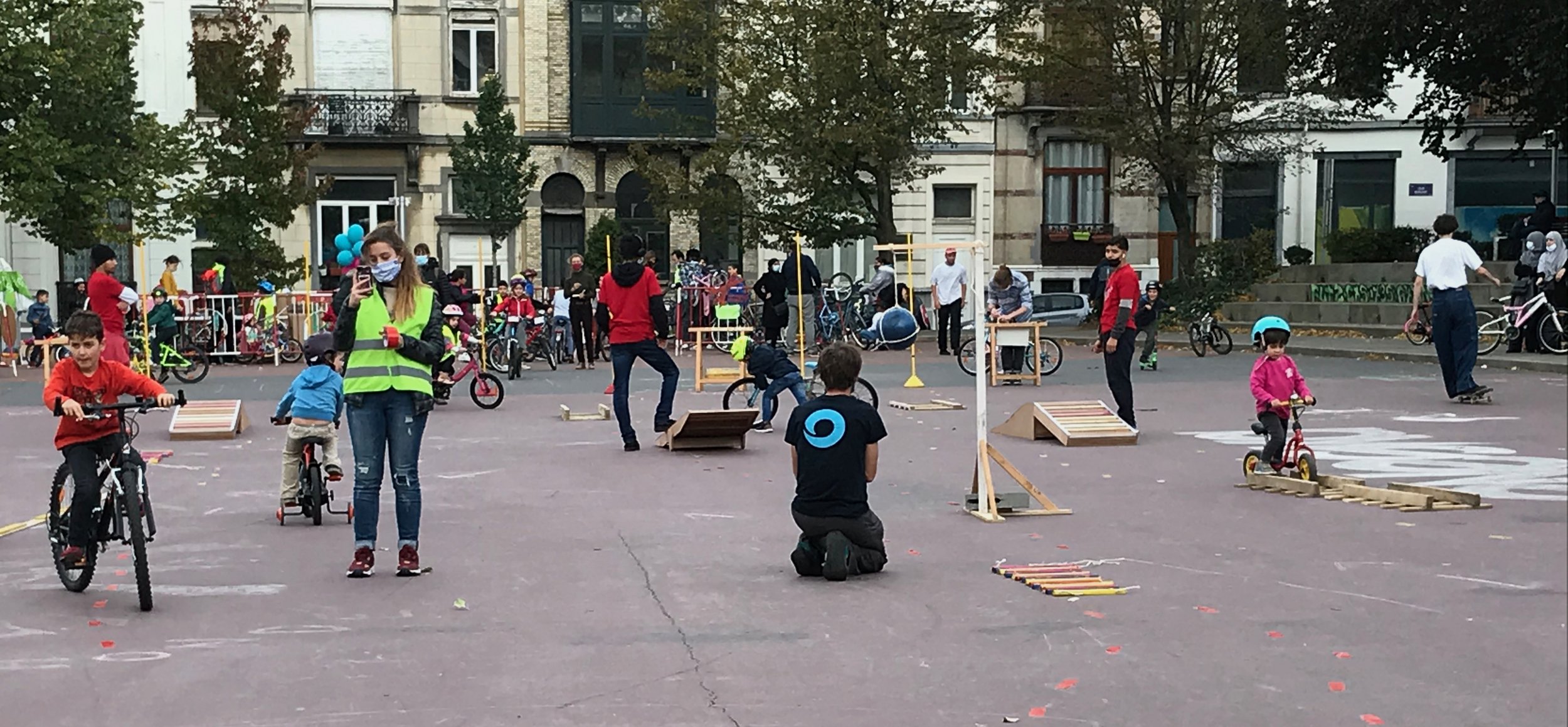
Project partners :
Recy K, platform for the circular and social economy in the Brussels Capital Region.
Commune of Ixelles (Brussels), office for the Environment, Energy and Green Spaces.
Pro-velo, association for support towards active mobility.
BAIU, the Library of Architecture, Architectural Engineering and Urban Planning of the University of Leuven.
BRAVVO, the City of Brussels' prevention service.
Jacques Franck Cultural Centre in the Commune of Saint Gilles, Brussels.
We are always open to exploring new partnerships, whether for our research or teaching programme, including for internships, dissertations or individual student projects. Please do not hesitate to contact us to discuss!
Academic Partners:


Please reach out!
Don’t hesitate to contact us if you’d like to discuss our academic or research programmes,
Please feel free to drop by our studio, or send us an email on: mdis@stluc-esa-bxl.org.

Follow us on social networks:
Research
RDIS: a strategic partner for research projects on societal challenges
The Centre for Research in Design for Social Innovation (RDIS), affiliated with the Master's in Design for Social Innovation at ST-LUC BXL Arts College, positions itself as a strategic partner within interdisciplinary research projects addressing major societal and transition challenges.
Within consortiums that may bring together universities, scientific centres, technical experts, associations, and public or private organisations, RDIS contributes complementary methodological expertise: a multidisciplinary and creative, experiential, human-centred approach, structured by collective intelligence and co-creation, for the deployment of societal innovations.
In practice, RDIS intervenes at different stages of a project — from the initial framing of the issue through to process evaluation — in order to:
refine and enrich the problem-framing by producing tools to facilitate collective intelligence processes, capturing field knowledge and creating a shared language with stakeholders;
design creative devices, both tangible and intangible (participatory tools, prototypes, narrative materials, platforms, boundary objects...) that enable research hypotheses to be tested with stakeholders, whether during the problem-framing phases or during the testing and improvement of solutions;
support the testing and iteration phases in order to improve solutions through contact with real-world uses;
formalise research outputs in the form of designs that meet the project specifications and propose technically feasible, economically viable, and humanly desirable solutions.
The creative devices (collaborative workshops, visualisation tools, intermediate prototypes, or narrative materials) aim to establish a common language among the different stakeholders, to reach a shared understanding of the problem, and to foster strategic alignment in order to collectively improve solutions.
By strengthening the ownership, acceptability, and impact of innovations, and through the empowerment of users, RDIS — acting as a catalyst between research, technology, and social transformation — increases the strategic robustness of projects and their capacity to generate measurable, lasting societal value.